The mathematics
Team SIMC10, three of us · Represented PSBB K.K. Nagar · Roles: modeller, coder, communicator
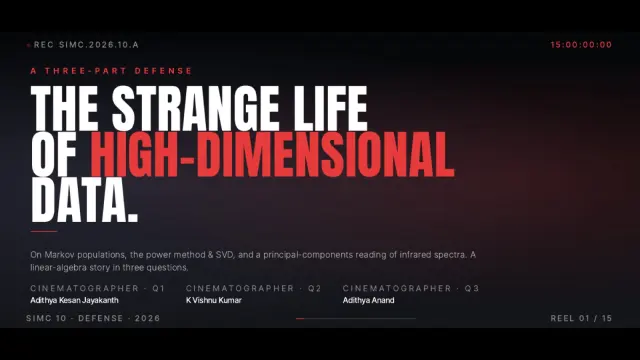
International finals in Singapore: a 3-day mathematical modelling competition hosted by NUS High School of Mathematics and Science with Singapore's Ministry of Education. One real-world problem set, about thirty hours to model it, write the report and present it to the judges.
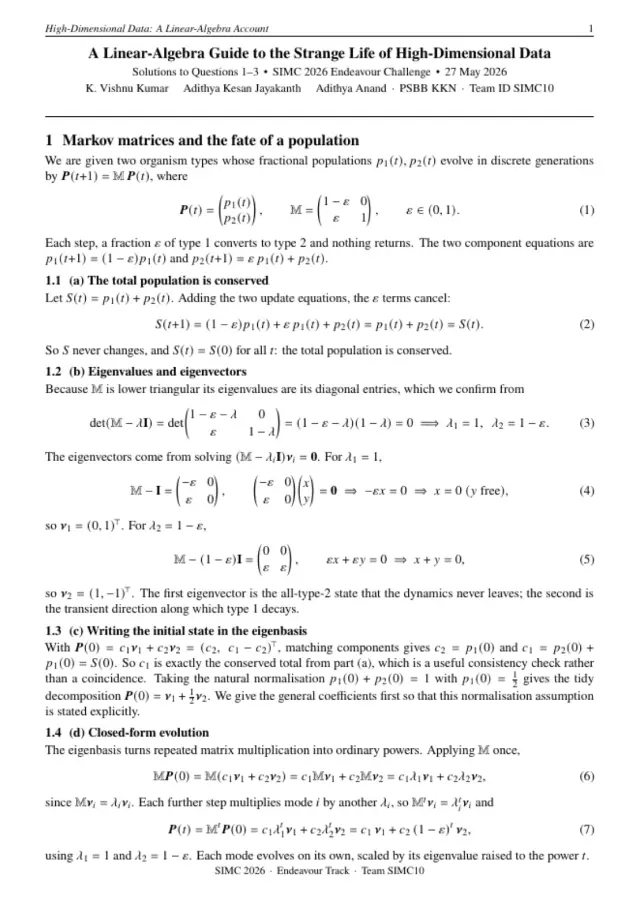
The 2026 paper was linear algebra end to end: a matrix of 1,000 infrared spectra with 3,401 channels each, to be cleaned, decomposed, clustered and counted, with the theory behind every step stated and proved along the way.
The strips, points and columns on the table behind this page are that matrix, drawn from my own re-analysis of it after the competition.
Spectra kept after cleaning by Euclidean row norm. Forty vials were empty, background noise with a norm near 1.6 below a clean gap, and the cut was stable anywhere between 2 and 4. Thirty-six more were high-norm outliers near 8.9, kept behind a Boolean mask rather than deleted; they turned out to be one isolated cluster of their own.
The eigenspectrum of the 3,401 × 3,401 covariance matrix: the first eigenvalue carries 31% of the total variance of 7.90, three and a half times the second, and the largest multiplicative drop, λ8/λ9 ≈ 4.1, puts the elbow at eight. The bare elbow is not bootstrap-stable and the "95% rule" would demand 667 components, so the number we stood behind was the participation ratio, (Σλ)² / Σλ², about 8.7 with a bootstrap interval of 7.6 to 10.0. Eight components keep about 55% of the variance at a 425-fold reduction, and by Eckart–Young that projection is the best rank-8 approximation there is.
Projected onto the top four eigenvectors, the 924 spectra fall into 25 clusters under one-pass leader clustering, stable for any radius between 6 and 12 times the median nearest-neighbour spacing. Twenty-four groups of about 37 replicate vials plus the 36 outliers make 924: about twenty-five distinct food samples. Then the same answer by the other route: the 924 × 924 Gram matrix shares its non-zero eigenvalues with the covariance matrix, costs (3401/924)² ≈ 13.5 times less to diagonalise, agrees on the top eight to 10⁻⁶, and gives the same 25 clusters, necessarily, because by the SVD both score matrices are UΣ up to a sign per axis.
The ideas, one at a time
Beside this text the table deals the ideas the work rested on, one card every few seconds, each named as it lands and each a small moving picture rather than a paragraph.
Ten weeks from zero
The team prepared on a dependency-ordered skill tree I wrote for three people starting from scratch: Tier 0 algebra, Python and "what is a model", through ODEs, NumPy and Euler's method, to the specialisation tracks for modeller, coder and communicator, with the hours budgeted per skill and a 30-hour competition plan at the end.
The practice was real papers. We solved the 2024 Endeavour Challenge end to end: 100,000 randomly rotated copies of a hidden master image, sorted into their four orientations by sum-of-squared-differences, then k-means on a thousand flattened patterns, then hard and soft expectation–maximisation with a Bernoulli log-likelihood on sparse photon counts, down to a master image recovered from patterns too noisy to read one at a time. Smaller exercises built the same habits: recovering a hidden base vector from 400 translated copies, first by sorting, then by frequency once the scalar was drawn from a discrete Gaussian; Euclidean distance in n dimensions with every input checked; a drainage simulation that was secretly an ODE.
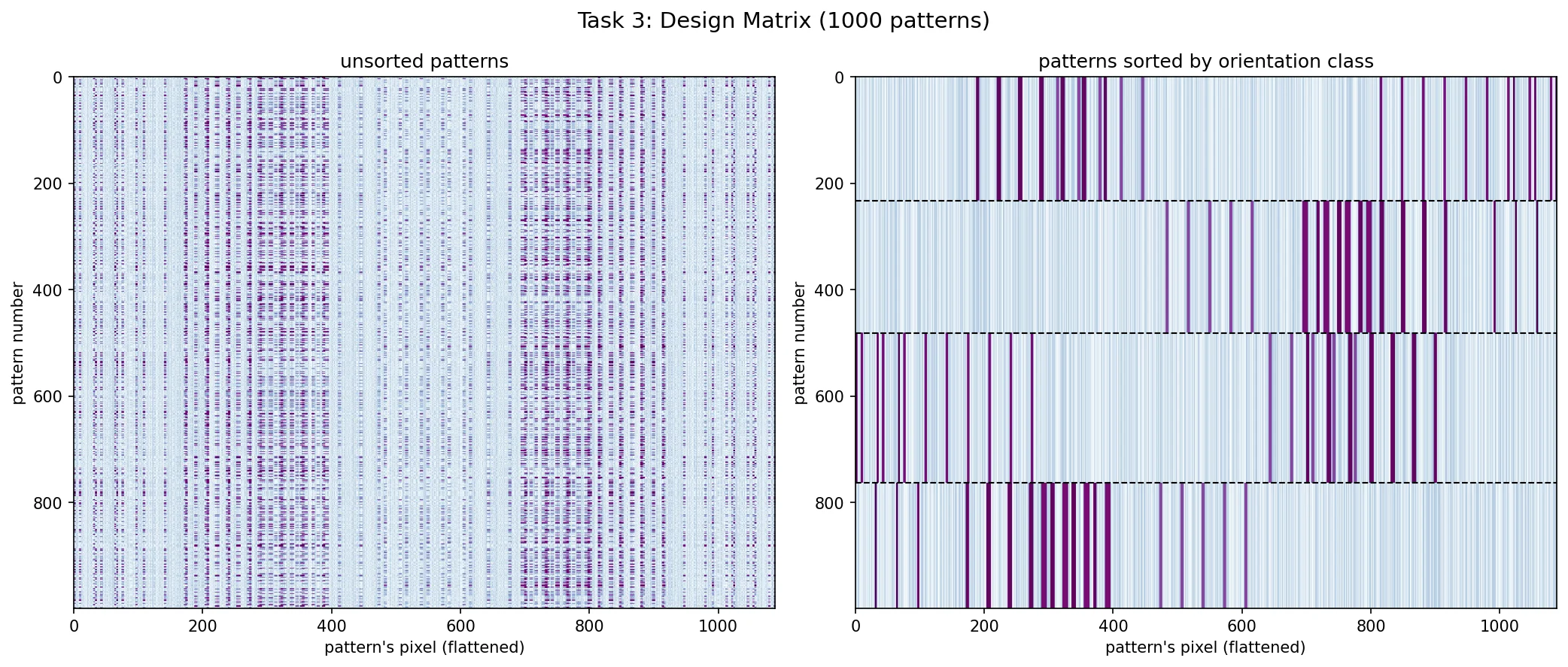
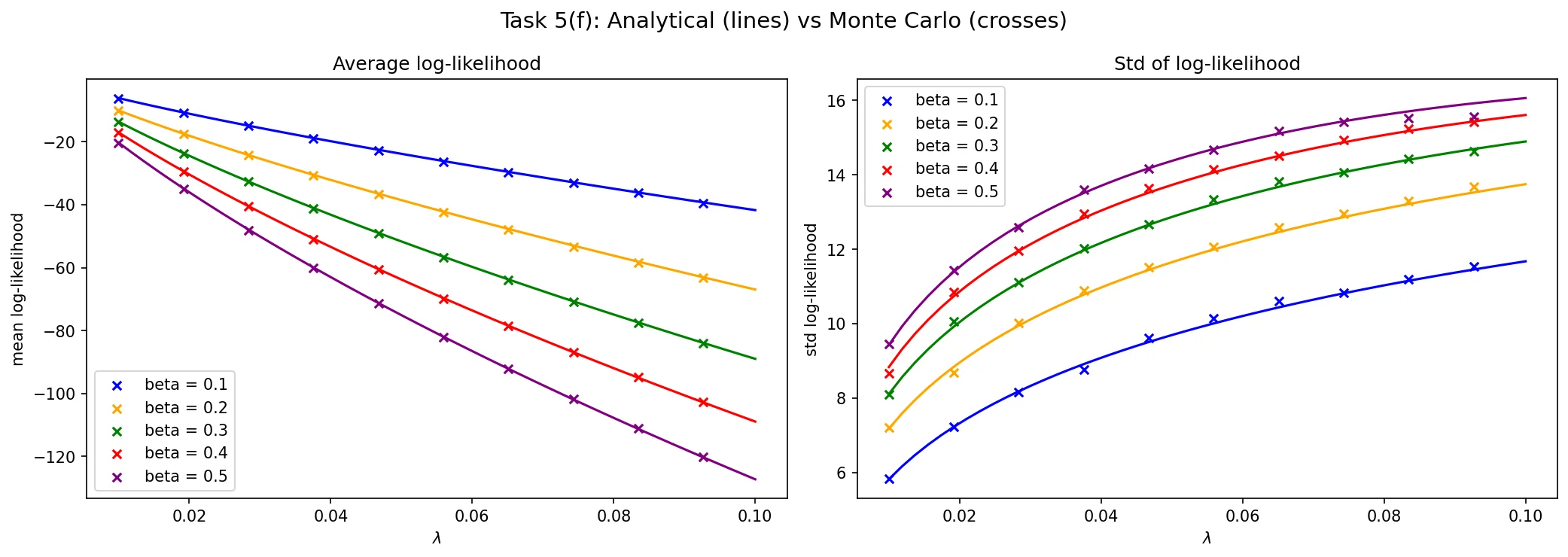
The 2024 paper taught the shape of the thing: start with a case you can check by eye, scale until the eye fails, then reach for likelihoods. The 2026 paper asked the same of linear algebra, and the cleaning threshold, the elbow and the cluster count were each checked for stability before we claimed them.
Afterwards: the foundations
After the competition I rebuilt the whole report from first principles as a pack of 75 atomic study notes in eight folders: linear algebra (30), statistics (12), machine learning (12), Markov dynamics (6), probability (5), Python (5), spectroscopy (3) and random matrix theory (2). Every note is one concept, intuition before formula, with a worked example and the exact part of the report where it is used.
It also closed the report's one weak spot. We had asserted a "multiplicative noise boundary" at the elbow without ever deriving a noise model. The Marchenko–Pastur law supplies it: for pure noise with aspect ratio γ = 3401/924 ≈ 3.68 the covariance eigenvalues fill a band whose upper edge is λ₊ = σ²(1 + √γ)². Even with σ² bounded conservatively from the total variance, λ₊ ≈ 0.02, and the first eight eigenvalues clear it by orders of magnitude, with λ₁ ≈ 2.45. The elbow we picked by eye is where the noise bulk begins.
Singapore, 24 to 29 May 2026
Three days of modelling at NUS High School of Mathematics and Science, the report, the defence in front of the judges, and the medals on the last evening. The photographs from the week survive only as small contact prints from a phone roll; the submission and the defence deck are the team's own.